The first mesh is alive
Tonight, for the first time, a Recilic shard left one Mac and landed on another. A MacBook and a Mac mini, one invite link, and a 61.9 GB photo library flowing across the room as encrypted shards. The mesh — the whole reason this product exists — drew its first breath.
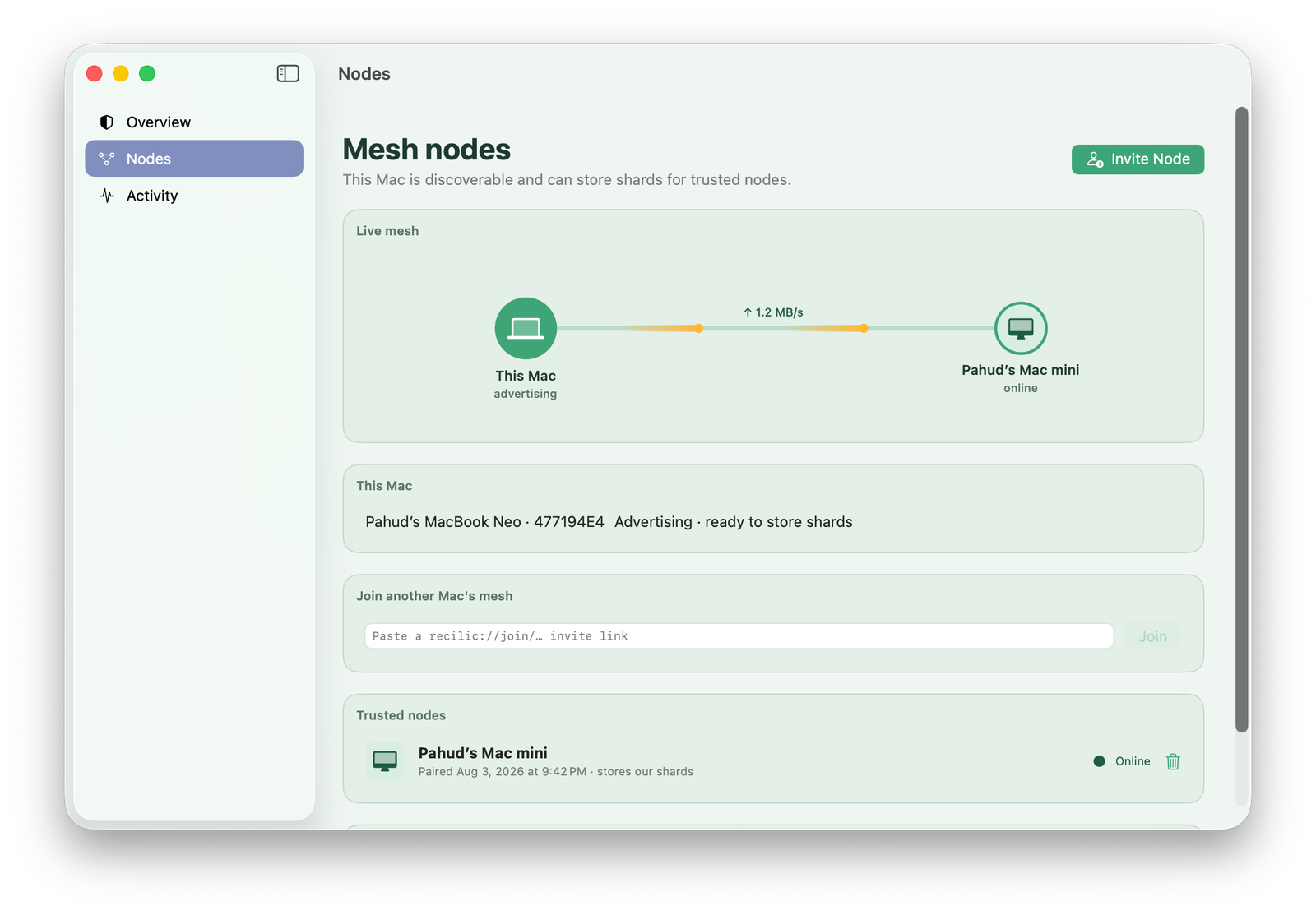
What you're looking at
The Live mesh view: the MacBook on the left is backing up, the Mac mini on the right is storing. The amber marquee streams in the direction the data flows, with the live rate on the edge. On the Mac mini's screen the same view shows the comets flowing inward — and an activity entry it can be proud of: "Stored 846 encrypted shards for Pahud's MacBook."
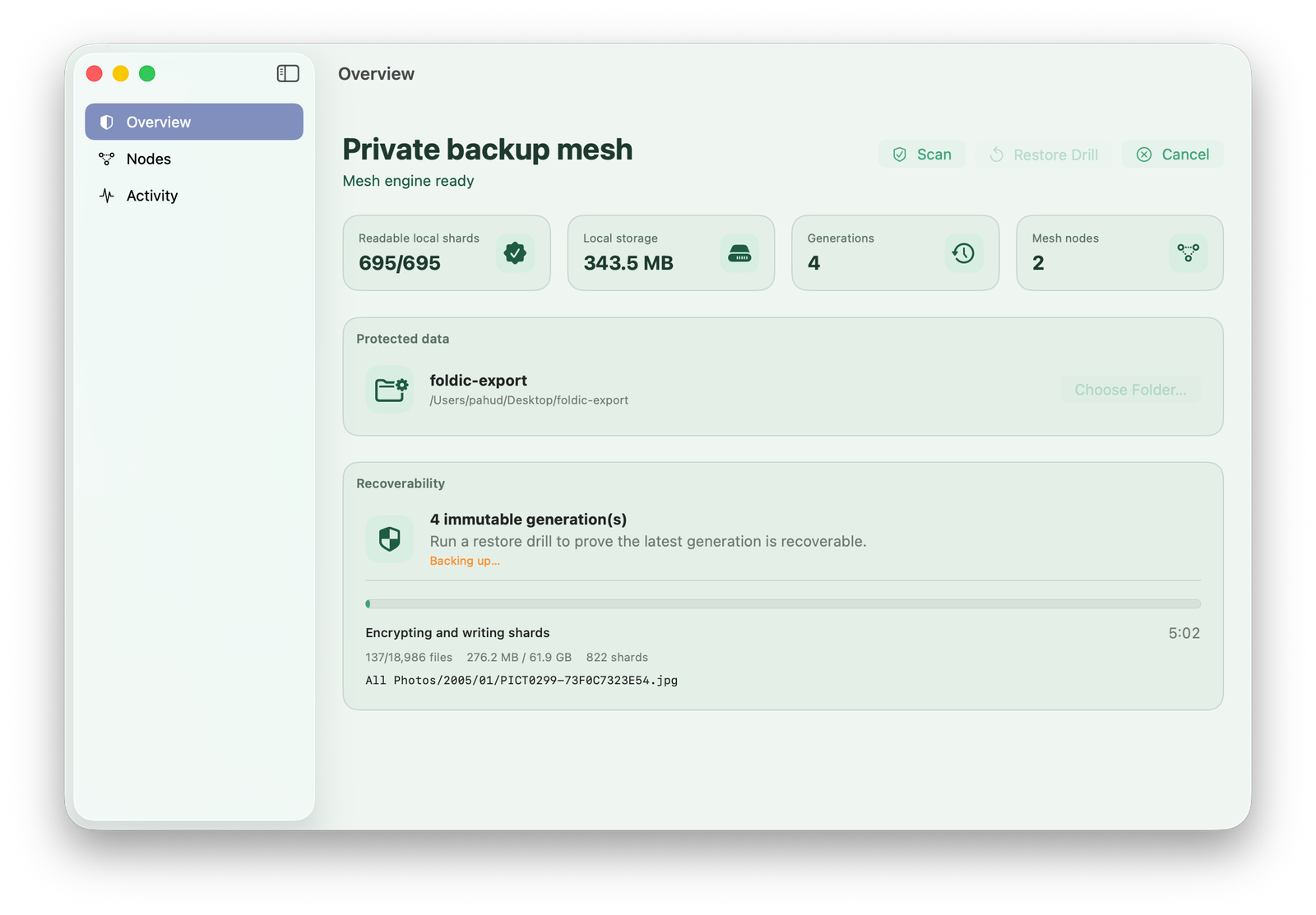
How the two Macs met
No accounts, no server, no configuration. The Mac mini generated a single-use invite link; the MacBook pasted it. Under the hood: Bonjour finds the peer on the LAN, an HMAC proof shows possession of the invite secret without ever putting it on the wire, both sides derive directional traffic keys from an ECDH handshake bound to the full transcript, and every reconnection proves possession of those keys cryptographically before a single shard moves. The invite died the moment it was used.
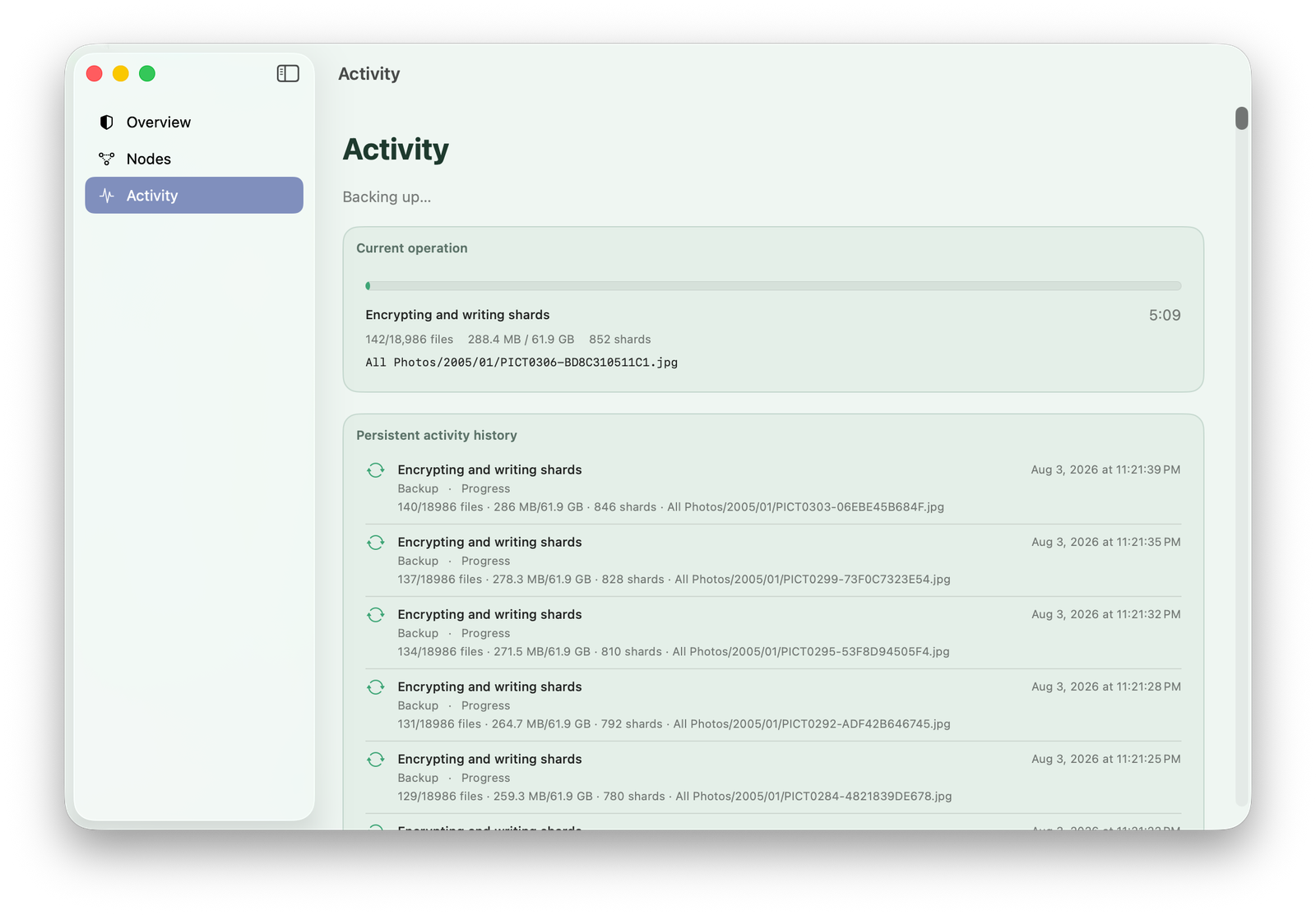
What the Mac mini can see
Everything it stores looks like this: 61b3a6aa….shard — an opaque blob named by its own hash. No filenames, no folder structure, no contents, no way to tell one file from another. And since each chunk needs any 4 of its 6 shards to reconstruct, a single node's hoard reconstructs exactly nothing. The friend who stores your backup cannot read your backup. That was the promise; now it's a screenshot.
Honest footnotes
This is phase one: two Macs on the same network. Cross-network friends, adaptive shard geometry, and node-death recovery are next. And with two nodes the survivability report says, truthfully, that losing a node still hurts — the 4+2 math wants a third node before it can shrug off a machine. That report never flatters; it's the whole point.